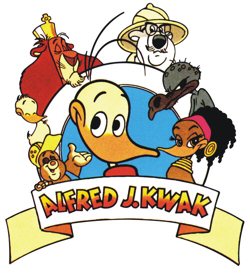
Article Alfred J. Kwak - Anime?

Introduction
For Dutch anime convention Abunai!'s 3rd year, 9-11 September 2005, the staff had created a daily 'newspaper' called the Abunai Daily. A new installment was released every day of the convention with articles written by Anneke Sinnema. One article was an interview with Harald Siepermann about the production of Alfred J. Kwak.[1]
Original link: http://www.abunaicon.nl/daily/abunai2005dailysunday.php#kwak
The article
Alfred J. Kwak - Anime?
Abunai Daily: Sunday
An often-heard argument anime fans use when trying to ‘convince’ non-anime fans of the quality of Japanese animation is: “The Alfred J. Kwak (Alfred J. Quack) cartoon was anime too!”
But was it really? Telescreens director of commercial affairs Sjoerd Ramaekers, who followed the production process very closely: “Absolutely not. It’s traditional 2d animation. Character designs came from Germany, story and scripts from the Netherlands. The Japanese only animated it, like they did ‘Ducktales’.”
Abunai Daily decided to investigate the origins of the show a bit further, and managed to ask Harald Siepermann, who worked as character designer on Disney’s Tarzan, Mulan, and most recently Brother Bear, some questions. Are there Japanese influences in the cartoon?
So, how did you get involved in designing Alfred J. Kwak?
Well, I was a young student of graphic, I had always admired Disney and all sorts of animation and comic strips, but never considered it as a realistic career. Neither did I want to spend the rest of my life in advertising. I knew Herman like anybody else from radio and television and one day by accident I got a chance to see him live on stage and his performance and character impressed me very much.
Spontaneously and unprepared I went backstage after the show, and I told him, that I would like to do with pencil and paper, what he was doing with his voice. Something meaningful, not just making money.
We started to work on a storyboard for a life-action-feature film first, but quickly the preparations for a performance of Kwak in Hamburg started and Herman asked me to do a poster for that, which I did. The show, although it ran only for a week on a festival, was pretty successful and we decided to do a comic strip of the theater show. After we had done a second and a third one, we were approached by a TV-producer, Dennis Livson, if we would be interested in doing a 52-part television series based on the strips. Well, the rest is history, really…
Are you familiar with anime?
Yes of course, I am familiar with anime, and I am very curious about it, since their approach to animation is really different to ours. We must not forget, that most of the stuff we know, is already made accessible for our European minds and tastes. True Anime is still very different to what we see in our cinemas. Nevertheless I try to see and understand as much of it as possible. Of course the person I admire the most, is Miyazaki and his wonderful movies.
What do you think of the way the Japanese studio (that has animated the best part of the cartoon) has animated Alfred J. Kwak?
Of course I am very pleased with the final result, although they had to make some quality cuts in order to keep it manageable. I was in Japan 4 or 5 times to talk with the studio about what we had in mind, answering their question and supervising the designs and stories. There were some misunderstanding or rather different understandings of what makes a character and what the stories should be about. In the beginning, they had some trouble with getting into the fact, that we are not really telling animal stories, although Kwak is a duck, it is really about humans in an animal shape. As opposed to, let’s say, Kimba the White Lion, he is still a lion, whereas Kwak is a guy like you and me. They were also quite surprised by the issues we addressed, but we sorted it out finally. We had to make some concessions, which was absolutely to the benefit of the stories: For example, we were not allowed to use crosses and crucifixes in the stories, so we replaced them with question marks, which I still like to this very day, it’s very philosophical, limitations are always good, they force you to be inventive.
Did you write or draw an animation bible?
Yes we did, it’s a big huge book with some 300 character designs[note 1], usually we got Hermans story ideas on a sheet of paper, Hans Bacher and I would do the character designs based on that, pass it on to Japan, were they would do the scripts and storyboards, which I would correct if necessary and then it would move on into animation. Only the storyboards for the first episode I did myself, to set a tone for the entire series and give an example of pace and style. The series and the storytelling is still rather slow, but that’s just the Japanese culture, they tell stories differently.
Did you personally contact the aforementioned Japanese studio, and did you encounter any cultural differences between animators?
We did encounter some differences, it started with small and sometimes funny things like: what does it mean: he gets goose bumps or “de gele kaart”?
Sometimes bigger issues like, is it honorable to leave your country and move somewhere else, like Kwak’s parents do in the first episode, or is that cowardice, shouldn’t Johan stay home to serve his country of birth in times of need against the builders? Sometimes we had long discussions about things like that.
Notes
- ↑ This is a slight exaggeration. There were about 268 character designs.
References
- ↑ Anneke Sinnema (18 September 2005). "Abunai daily". abunaicon.nl. Archived from the original on 14 January 2006.