Alfred J. Kwak Episode 2
|
|
| Alfred J. Kwak 初めてのバースデー (Hajimete no bāsudē) "First birthday" | |
|---|---|
| Season 1, Episode 2 | |
| |
Animation Staff | |
| Episode direction | Shigeo Koshi |
| Animation direction | Osamu Kamijō |
| Episode storyboards | Hiroshi Saitō |
| Screenplay | Akira Miyazaki |
| Music | Herman van Veen Erik van der Wurff Nard Reijnders |
| Sound director | Shigeharu Shiba |
| Running time | 25 min |
| Original airdate | 10/4/1989 (Japan) |
| Original production episode number | 2 |


"Het verjaardagsfeestje" (lit: The Birthday Party) or "初めてのバースデー" (Hajimete no bāsudē; lit: First birthday) is the 2nd episode of Alfred J. Kwak's first season. The episode first aired in Japan on TV Tokyo on 10 April 1989 in the Monday 17:00 - 17:30 slot. The episode picks up the story directly from the events of the previous episode and concludes with a cliffhanger that leads into the next episode.
Story
Summary
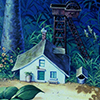
Johan Sebastiaan Kwak, Anna van de Polder, and their children begin their emigration from Breed Rietland to Groot Waterland, bringing their living clog with them. They are accompanied by Henk de Mol, who once again shows Johan the photograph of his grandfather, with the mine house visible in the image. Johan comments that the place must be very quiet. Behind them, fireworks illuminate the sky, marking the official opening of the theme park Groot Speelgoedland. Johan becomes visibly upset, but Anna calms him. Their son, Alfred Jodocus Kwak, is momentarily distracted by a butterfly and wanders off. Henk chases after him, leaving behind the photograph, which Johan then stores safely under his hat. As they continue walking, Anna quietly expresses her disapproval of the Beton Maatschappij.
At the Beton Maatschappij office, Alfons Rokodil, Olaf Nijlpaard, and Bart 'Beton' Bever boast about the profits made on Groot Speelgoedland’s opening day. As they prepare to deposit the earnings at the bank, their car backs into a statue in the courtyard before speeding off, leaving Bart behind.
As the weather worsens and heavy rain begins to fall, Johan and his family prepare to cross the road into Groot Waterland. Alfred spots a frog and runs off after it, with Henk in pursuit.
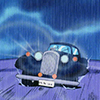
Meanwhile, Rokodil and Nijlpaard are distracted by the radio when a sudden lightning strike startles them, causing their car to veer off course. They strike Johan, Anna, and their children as they are crossing the road. The car does not stop and drives on. From a distance, Henk hears the accident and rushes to the road. All that remains is the living clog and the photograph of his grandfather’s mine. Alfred, now by Henk’s side, is unable to fully grasp what has happened. Henk attempts to comfort him.
Some time later, Henk finds Alfred sitting outside the mine house. Although they have now settled in, Alfred refuses to eat. Henk gently encourages him, warning that if he doesn't eat, he may fall ill—something his parents would certainly not have wanted. As Alfred reluctantly returns to the house, Henk reflects on his new responsibility, stating that he will raise Alfred until adulthood. He adds that he will serve as both mother and father to him, but admits there is one thing he cannot teach: how to swim.
The months and the seasons pass and on Alfred's first birthday Henk prepares a party. In the morning he prepares the table with a present and checks to see if Alfred's already awake. Alfred would love to sleep in a little and Henk lets him.
In Polderstad, Pikkie de Ekster flies erratically and crash-lands at the door of the house of Ollie de Ooievaar. Ollie opens the door and invites Pikkie in. Curious about what Ollie has prepared as a present for Alfred, Pikkie asks, but Ollie keeps it a secret. Pikkie then reveals the silver spoon he intends to give as a gift, admiring its beauty.
Ollie and Pikkie depart together for the mine house, where they arrive alongside Hannes, Wannes, and the sparrow triplets, and are welcomed by Henk de Mol. The festivities begin with cake, drinks, and a few party poppers, followed by a game of Game of the Goose.
When Henk opens a window, sunlight reflects off a key worn by one of the sparrow triplets on a rope around their neck. Pikkie begins to hallucinate, imagining the key speaking to her and urging her to take it. She and the sparrow tug on the rope until it snaps. Snapped out of her trance, Pikkie is confused, as are the others. Henk speculates that this may be an instinctive reaction due to Pikkie being a magpie, something Pikkie herself hears for the first time. Before the conversation can continue, a bus horn is heard from outside.
Henk’s present for Alfred is a group visit to the King's castle. During the bus ride, the children ask whether they will get to see the King, but Henk explains that they likely won’t. According to him, the King is usually out hunting on Wednesdays, as that is the day when many tourists visit the castle.
The King is out hunting, carried in a litter by his hunters, and accompanied by a grumpy Jonkheer Das. During the excursion, the King destroys a sign intended to warn outsiders of royal hunting activity. Mistaking the honking of a passing bus for the call of a deer in heat, he prepares to shoot at it—only to be interrupted when one of the hunters trips, causing the King to fall from the litter.
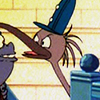
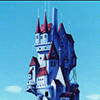
Inside the castle, Jonkheer Poen van Kale Koen gives Alfred and his group a guided tour, beginning with a portrait of Otto the Third, depicted near the great castle of Otterdom. Alfred is momentarily distracted by his own reflection in the polished floor and pillars, but Henk de Mol quickly retrieves him, and the group continues into the kitchen. There, the brothers Do, Re and Mi Lano are seen preparing noodles through an elaborate culinary ritual involving a hand-cranked pasta machine.
While the tour guide continues, Alfred encounters one of the King's guards standing completely motionless. Mistaking the guard for a mannequin, Alfred pokes him, only to be startled when the guard suddenly sneezes—prompting Alfred to flee in fright.
The tour continues into the castle's cellar, where Jonkheer Poen displays a fully functioning guillotine to the visitors.
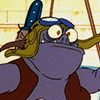
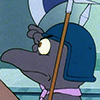
The next stop is the treasury room. Two soldiers stand waiting outside, while inside the vault another two soldiers stand guard, blindfolded as to not be blinded by the pink rays of the crown jewel. This crown jewel is, according to Jonkheer Poen, the most expensive stone on the planet. While the group leaves the treasury room after Jonkheer Poen's story about it has concluded, Pikkie de Ekster remains enthralled by the ruby.
Jonkheer Poen van Kale Koen continues the castle tour by showing the group the King's personal lemonade bath. During this time, Alfred notices that Pikkie de Ekster has gone missing and breaks away from the group to start looking for him.
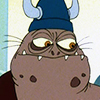
Suddenly, two masked soldiers burst out of the treasury room: the King's ruby has been stolen. The soldiers pass on the news all the way to the head guard, who immediately orders the drawbridge to be raised and commands all available guards to search for the thief. In the ensuing commotion, soldiers scramble throughout the castle, running past Jonkheer Poen and Alfred’s birthday party group.
While Alfred searches desperately for Pikkie, Pikkie is revealed to be high above in the ceiling rafters, obsessively rolling the ruby along a narrow ledge. Miscalculating, he accidentally sends the ruby tumbling off the ledge, and it lands directly on Alfred's head. Alfred collapses next to the gem. Pikkie, realizing what has happened, looks on from above.
The King's soldiers arrive and, upon seeing Alfred unconscious beside the ruby, declare that they have found the thief. Alfred, confused and disoriented, asks what happened but is immediately shackled to a large iron ball and imprisoned in the castle’s cellar by the jailer. Alfred calls out to his father, insisting he is innocent.
Language and Regional Variations
- The following lists differences between the Dutch version and other versions. For detailed information on music differences check the Music section. General differences between series like names can be found at Alfred J. Kwak Production
- The Dutch and German version does not mention where Olaf Nijlpaard and Alfons Rokodil are going to after receiving the money from the opening of Groot Speelgoedland, but in the Japanes and English version Olaf explicitely says they are going to the bank to deposit the money they just earned.
- Jonkheer Poen van Kale Koen quite consistantly uses the translation of "Open Sesame" in most languages to open the vault door of the treasury room.
- As can be seen in the Character gallery Locations section several historical figures and places Jonkheer Poen van Kale Koen mentions over the tour have different names in different languages.
Continuity
- This episode forms one cohesive story together with Episode 1 and Episode 3.
- Henk de Mol says he can't teach Alfred how to swim. This does not come into play later on the series, in fact Alfred is seen swimming perfectly in Episode 6.
- The scene where Alfred mistakes one of the large guards for a giant doll closely mirrors a moment from the first episode, in which Alfred similarly mistakes a large animatronic gorilla for an inanimate figure before being startled.
- From the time Henk de Mol and Alfred begin living at Henk's grandfather's mine house, Alfred is seen with a stuffed animal resembling a yellow duck wearing a red scarf. This serves as a visual reference to the design Alfred adopts starting in episode 4 of the animated series.
- Jonkheer Poen van Kale Koen also appears in the original theater plays, but under the name Jonkheer Koen van Kale Poen, switching the K and the P.
- By the time of episode 20, after King Franz Ferdinand takes over the throne, most of the riches from the castle's treasury room had been sold off, including what Jonkheer Poen van Kale Koen calls "the most expensive stone on this planet".
Cultural references
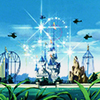
- The finished version of Groot Speelgoedland, particularly the design of its central castle, bears a striking resemblance to the iconic castle found in Disneyland. This visual similarity serves as a likely reference, reinforcing the idea that Groot Speelgoedland is intended as a satirical counterpart to the famous theme park.
- The story of Pikkie de Ekster, which explores how magpies are naturally drawn to steal shiny objects and how someone else may be punished for actions that are instinctive to a magpie but not criminal in intent, bears a striking resemblance to the story The Thieving Magpie. Check the production chapter for a more detailed breakdown.[1]
- Alfred and the others play the Game of the Goose, which is thought to have originated in Italy during the 15th century.[2] In Alfred J. Kwak Episode 4 both Dolf de Kraai and Alfred end up stuck in a well, which is one of the hazard spaces from the board game.[3]

Errata
- When Olaf Nijlpaard descends from the stairs Bart 'Beton' Bever pops up in the background without emerging from the room they were in. In the next shot, it's Alfons Rokodil that pops up from the entrance to the building.
- In the shot where Olaf Nijlpaard enters the car, Bart 'Bever'Beton's chin is miscolored to be the same as the rest of his face.
- An animation error occurs in the scene where Jonkheer Poen van Kale Koen guides Alfred's party to the treasury of the King's castle. One of the guards stationed at the vault entrance is incorrectly positioned in front of the open vault door instead of behind it. This error appears to be due to an incorrect layering of animation cells.
- During the crisis scene, several guards are seen running past Jonkheer Poen van Kale Koen and the rest of the group. Soldier 4 and Soldier 13, as identified in the Character gallery, appear to run past twice.
Cast
|
ヨハン・クワック
Yohan Kuwakku |
吉村 よう Yō Yoshimura |
|
|
アンナ・ポルダー
Anna Porudā |
安達 忍 Shinobu Adachi |

|
|
ハンク
Hanku |
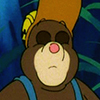
緒方 賢一 Kenichi Ogata |

|
|
アルフレッド・ヨードカス・クワック
Arufureddo Yōdokasu Kuwakku |
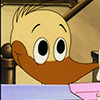
林原 めぐみ Megumi Hayashibara |

|
| File:Episode2 Alfred's brothers and sisters.jpg | Alfred's brothers and sisters | Unknown | 
|
| File:Episode2 Alfred "Jodocus" de Mol.jpg | アルフレッド
Arufureddo |
Unknown |
|
| File:Episode2 Olaf Nijlpaard.jpg | ヒポポタマス (not named) Hipopotamasu |
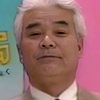
神山 卓三 Takuzō Kamiyama |
|
| File:Episode2 Alfons Rokodil.jpg | クロコダイル
Kurokodairu |
立木 文彦 Fumihiko Tachiki |

|
| File:Episode2 Bart 'Beton' Bever.jpg | バート
Bāto |
Unknown |
|
|
|
Johan Sebastiaan Kwak | Herman van Veen | 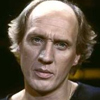
|
|
|
Anna van de Polder | Marlous Fluitsma | 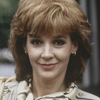
|
|
|
Henk de Mol | Frits Lambrechts | 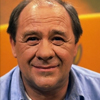
|
|
|
Alfred Jodocus Kwak | Ryan van den Akker | 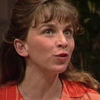
|
| File:Episode2 Alfred's brothers and sisters.jpg | Alfred's brothers and sisters | Unknown |
|
| File:Episode2 Alfred "Jodocus" de Mol.jpg | Alfred "Jodocus" de Mol | Unknown |
|
| File:Episode2 Olaf Nijlpaard.jpg | Olaf Nijlpaard[4][5] (not named) |
Kees Schilperoort | 
|
| File:Episode2 Alfons Rokodil.jpg | Alfons Rokodil | Bram van der Vlugt | 
|
| File:Episode2 Bart 'Beton' Bever.jpg | Bart 'Beton' Bever | Fred Butter |
|
|
|
Johan Sebastian Kwak | Herman van Veen |
|
|
|
Anna van de Polder | Marlous Fluitsma |
|
|
|
Maulwurf Henk | Klaus Sonnenschein | 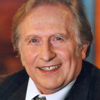
|
|
|
Alfred Jodocus Kwak | Ryan van den Akker |
|
| File:Episode2 Alfred's brothers and sisters.jpg | Alfred's brothers and sisters | Unknown |
|
| File:Episode2 Alfred "Jodocus" de Mol.jpg | Alfred | Unknown |
|
| File:Episode2 Olaf Nijlpaard.jpg | Hippo Nilpferd (not named) |
Wolfgang Völz |
|
| File:Episode2 Alfons Rokodil.jpg | Alfons Rokodil | Hans Teuscher |
|
| File:Episode2 Bart 'Beton' Bever.jpg | Bert Beton | Unknown |
|
|
|
Johan Quack | Unknown |
|
|
|
Anna Polder | Unknown |
|
|
|
Henk | John Baddeley | 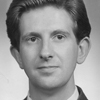
|
|
|
Alfred Johnathan Quack | Jill Lidstone |
|
| File:Episode2 Alfred's brothers and sisters.jpg | Alfred's brothers and sisters | Unknown |
|
| File:Episode2 Alfred "Jodocus" de Mol.jpg | Alfred | Unknown |
|
| File:Episode2 Olaf Nijlpaard.jpg | Hippopotamus (not named) |
Unknown |
|
| File:Episode2 Alfons Rokodil.jpg | Crocodile | Unknown |
|
| File:Episode2 Bart 'Beton' Bever.jpg | Bart | Unknown |
|
Character Gallery
The characters in order of appearance.
Main characters
|
|
ヨハン・クワック
Yohan Kuwakku |
吉村 よう Yō Yoshimura |
|
|
|
アンナ・ポルダー
Anna Porudā |
安達 忍 Shinobu Adachi |
|
|
|
ハンク
Hanku |
緒方 賢一 Kenichi Ogata |
|
|
|
アルフレッド・ヨードカス・クワック
Arufureddo Yōdokasu Kuwakku |
林原 めぐみ Megumi Hayashibara |
|
Main characters
|
|
Johan Sebastiaan Kwak | Herman van Veen |
|
|
|
Anna van de Polder | Marlous Fluitsma |
|
|
|
Henk de Mol | Frits Lambrechts |
|
|
|
Alfred Jodocus Kwak | Ryan van den Akker |
|
Main characters
|
|
Johan Sebastian Kwak | Herman van Veen |
|
|
|
Anna van de Polder | Marlous Fluitsma |
|
|
|
Maulwurf Henk | Klaus Sonnenschein |
|
|
|
Alfred Jodocus Kwak | Ryan van den Akker |
|
Main characters
|
|
Johan Quack | Unknown |
|
|
|
Anna Polder | Unknown |
|
|
|
Henk | John Baddeley |
|
|
|
Alfred Johnathan Quack | Jill Lidstone |
|
-
-
-
-
-
-
-
-
-
-
-
-
-
-
-
-
-
-
-
-
-
-
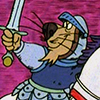 オットー王 (mentioned)
Ottō-ō
(King Otto) -
リチャード1世 (mentioned)
Richādo Issei
(Richard the first) -
-
-
-
-
-
-
リチャード3世 (mentioned)
Richādo Sansei
(Richard the third) -
-
-
ハンフリー2世 (mentioned)
Hanfurī Nisei
(Humphrey the second) -
-
-
-
-

-
-
-
-
-
-
-
-
-
-
-
-
-
-
-
-
-
-
-
-
-
-
-
-
-
-
-
Otto de Derde (mentioned)
-
Joris de Woeste (mentioned)
-
Richard de Eerste (mentioned)
-
-
-
-
-
-
-
Richard de Derde (mentioned)
-
-
-
Hanzobal de Tweede (mentioned)
-
-
-
-
-
-
-
-
-
-
-
-
]]
-
-
-
-
-
-
-
-
-
-
-
-
-
-
-
-
-
-
-
-
Otto dem Dritten (mentioned)
-
-
-
-
-
-
-
Richard des Dritten (mentioned)
-
-
-
Hanzobal die Zweiten (mentioned)
-
-
-
-
-
-
-
-
-
-
-
-
-
-
-
-
-
-
-
-
-
-
-
-
-
-
-
-
-
-
-
-
Otto the first (mentioned)
-
Richard the first (mentioned)
-
-
-
-
-
-
-
Richard de Derde (mentioned)
-
-
-
-
-
-
-
-
-
-
-
-
Voice Actors
| 緒方 賢一 Kenichi Ogata |
¦ | ハンク (Hanku) Hank (Henk de Mol) |
| 吉村 よう Yō Yoshimura |
¦ | ヨハン・クワック (Yohan Kuwakku) Johan Kwak (Johan Sebastiaan Kwak) |
| 安達 忍 Shinobu Adachi |
¦ | アンナ・ポルダー (Anna Porudā) Anna Polder (Anna van de Polder) |
| 神山 卓三 Takuzō Kamiyama |
¦ | ヒポポタマス (Hipopotamasu) Hippopotamus (Olaf Nijlpaard) |
| 立木 文彦 Fumihiko Tachiki |
¦ | クロコダイル (Kurokodairu) Crocodile (Alfons Rokodil) |
| 林原 めぐみ Megumi Hayashibara |
¦ | アルフレッド・ヨードカス・クワック (Arufureddo Yōdokasu Kuwakku) Alfred Jodocus Kwak |
| John Baddeley | ¦ | Hank the Mole (Henk de Mol) |
| Jill Lidstone/Ryan van den Akker | ¦ | Alfred Jonathan Quack (Alfred Jodocus Kwak) |
| Alan Carr Steve Cooke Melvyn Hayes Hugo Myatt Lyn Beardsall to be checked |
¦ | Other voices |
Main staff
- Original idea and storylines: Herman van Veen[6]
- Series director: Hiroshi Saitō[6]
- Excecutive producer: Dennis Livson[7]
- Producers: Manabe Tamura (Telescreen), Mutsuo Shimizu, Sumio Takahashi (Teleimage)
- Production managers: Manabe Tamura, Tamehide Hyakuzuka, Tsuneomi Nakamura[note 1] (TV Tokyo)
- Screenplay: Akira Miyazaki
- Animation supervisor: Osamu Kamijō
- Director of photography: Hisao Shirai
- Character designs: Harald Siepermann[6], Hans Bacher, Susume Shiraume, Masaru Amamizu
- Background designs: Hans Bacher
- Episode director: Shigeo Koshi
- Assistant director: ???
- Storyboard director: Akira Miyazaki
- Storyboard supervisor: Harald Siepermann
- Storyboard artist: Hiroshi Saitō, Harald Siepermann (uncredited)
- Key animation: Jōji Yanase, Minoru Kibata, Hiroshi Dobashi, Kaku Saito(?), Asunaro Studio, Emiko Kataoka, Yukari Watanabe, Tetsuro Kaku, Yumi Chiba
- Backgrounds: Hiroshi Yoshikawa, Maki Yoneda, Yukari Oba(?), Studio Uni
- Music: Herman van Veen[6], Erik van der Wurff[6], Nard Reijnders
- Lyrics: Herman van Veen
- Sound director: Shigeharu Shiba
- Sound mixing: Kunio Kuwahara
- Sound effects: Kazutoshi Satō (E&M Planning Center)
- Sound staff: Fujio Yamada, Shigeki Oashi(?, possibly correct)
- Sound produced by: Omnibus Promotion
- Recording studio: New Japan Studio
Localization staff
- Dubbing: J.P.S. Studio
- Technical Director: Joop Pieete
- Dutch Texts: Herman van Veen
- Script Adaptation: Vivian Pieters
- Production and Direction: Vivian Pieters
- Dutch Version: Telecable Benelux B.V., commissioned by Vara
- Dubbing: F.C.F. Film Synchronization, Berlin, commissioned by ZDF, ORF and SRG
- Dialogue editing and direction: Friedbert Cierpka
- ZDF Editorial Team: Markus Schächter, Dorothee Herrmann
- Dubbing: E.P.K Work in Arts, Bray Studios UK
- Direction: Stanley Joseph
- Dubbing editor: Russell Shaw
Locations
-

-
-
-
-
-
-
-
-
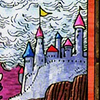 Ottodom
-
-
-
-
-
-
-
-
-
Otterdom
-
-
-
-
-
-
-
-
-
Das Schloss von Ritterstadt (Lit. The Castle of Knightcity)
Production
Scripts
While for this episode no original outline was publically released, based on the outline of episode 1 it is likely that this episode mostly consisted of the story of Alfred's birthday and subsequent visit to the King's castle, ending on the same cliffhanger as the final episode did. This is supported by a character design of Alfred chained to a steel ball, labeled for both episodes 2 and episode 3, seen below.
The story of Pikkie de Ekster, which explores how magpies are naturally drawn to steal shiny objects and how someone else may be punished for actions that are instinctive to a magpie but not criminal in intent, bears a striking resemblance to the story of The Thieving Magpie. The most famous performance of this story is the Italian La gazza ladra (lit. The Thieving Magpie). This melodramma is a two-act opera by Gioachino Rossini about a magpie that steals a spoon from the household of Fabrizio Vingradito. One of the servants, Ninetta, is wrongly accused of the theft and sentenced to death. At the last moment, the prison warden and Fabrizio’s manservant discover that a magpie was responsible, saving Ninetta just in time.[1]
This episode appears to reference the opera, with Alfred Jodocus Kwak occupying a role similar to that of Ninetta. Pikkie de Ekster also starts specifically with a silver spoon at the start of the animated episode, solidifying the reference. The ending to the next episode mirrors the ending to the opera as well.
Character Designs
Several character designs specific to this episode were shown in the behind-the-scenes documentary Wie wird eine Ente zum Fernsehstar? - Die Entstehung der Zeichentrickfigur Alfred J. Kwak when someone is flipping through the Character- and Color-Designs for Alfred J. Kwak book. On these sheets we can see that hunter 1, 2 and 3 look slightly different from their eventual animated version and the dog from that character design page was eventually unused.
-
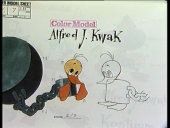 Alfred Jodocus Kwak chained to a big steel ball, character sheet number: 13/1 - 7, March 1988
 -
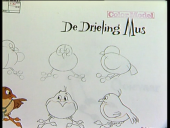 De Drieling Mus including one of them wearing the Shiny key, character sheet number: 18/2, 19/2, 20/2, March 1988
 -
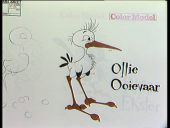 Ollie Ooievaar, character sheet number: 21/2, April 1988
 -
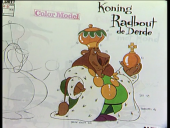 Radbout de Derde, character sheet number: 23/2, April 1988
 -
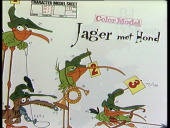 Jager met Hond, character sheet number: 24/2, 25/2, 26/2, May 1988
 -
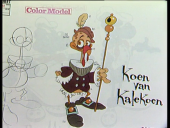 Koen van Kalekoen, character sheet number: 28/2, May 1988
 -
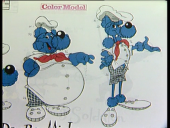 Do, Re, Mi Lano, character sheet number: 29/2, 30/2, 31/2, June 1988
 -
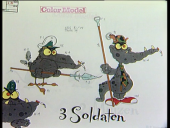 3 Soldaten, character sheet number: 32/2, 33/2, 34/2, June 1988


Storyboards
During the behind-the-scenes documentary Wie wird eine Ente zum Fernsehstar? - Die Entstehung der Zeichentrickfigur Alfred J. Kwak several glimpses of the storyboard for this episode can be seen, originally drawn by Harald Siepermann, specifally from the first few scenes from this episode. These may be preliminary storyboards created to guide the animation team in understanding the intended direction.


Cel gallery


Music
The following table is a list of the musical cues used in this episode, accompanied by our in-house wiki ids. The Opening and Ending songs Yakusoku Dayo and Happy Happy are performed by Megumi Hayashibara. A7 / Nog Nooit is sung by Herman van Veen.
| Alfred J. Kwak: Episode 2 Japanese OST | |||||
|---|---|---|---|---|---|
| Catalogue | NTSC Time Range | Title | Literal Translation | Wiki ID | |
| OP | 0:00 - 1:30 | It's a Promise | |||
| TC | 1:31 - 1:36 | M-3A | |||
| A1 | ' | M-23A(?) | |||
| A2 | Rote Wangen | ||||
| A3 | K. Rokodil | ||||
| A4 | Ben Jij Het? | ||||
| A5 | Untitled Cue | ||||
| A6 | Untitled Cue | ||||
| A7 | Untitled Cue | ||||
| A8 | Untitled Cue | ||||
| A9 | Untitled Cue | ||||
| A10 | De Eendjes En De Tweetjes | ||||
| A11 | Alfred's Verjaardag | ||||
| B1 | Zo Vrolijk | ||||
| B2 | Help Help (Variation) | ||||
| B3 | Untitled Cue | ||||
| B4 | Wat Gebeurt Daar? | ||||
| B5 | Kijk Niet Om | ||||
| EP[note 2] | Unknown | Unknown | M-4A | ||
| ED | TODO | Happy Happy (TV Size) |
Happy Happy | M-5B | |
Availability
This episode has been released in the following formats.
VHS
Dutch
-
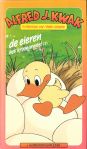 SKV 037 De eieren (1989) (Dutch)
 -
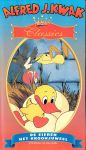 SKV 145 Classics: De Eieren (1990) (Dutch)
 -
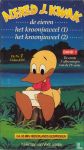 Alfred J. Kwak Band 1 (1990) (Dutch)
Finnish
-
 I-07116 Alfred J. Kwak - Kuinka Kaikki Alkoi (1995) (Finnish)
French
-
410001 Alfred J. Kwak - Nº1 (Unknown) (French)
-
 Alfred J. Kwak - Coffret 6 vidéos (VHS Box, WS 557) (1998) (French)
German
Hebrew


DVD
Dutch
-
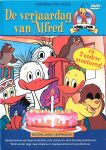 MBI 6067 De verjaardag van Alfred (2004) (Dutch)
 -
 MBI 6067 De verjaardag van Alfred (2004) (Dutch) (Alternate cover)
 -
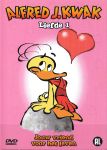 DDVD 904247 Liefde 1 (2006) (Dutch)
Finnish
-
Alfred J. Kwak (DVD Box, 7802) (2009) (Finnish)
-
Alfred J. Kwak - 1 Jaksot 1-7 (DVD, 7855) (2009) (Finnish)
German
-
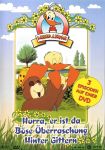 PTD 2834 Episode 1, 2, 3 (2001) (German)
Streaming
Dutch
- The complete episode is available in Dutch on Harlekijn Holland's YouTube page down below.
Removed
- The series used to be available trough Netflix in the Netherlands around 2015[8], but was removed sometime after[9].
Adaptations
Several adaptations have been made of the story contained in this episode.
Audio cassette
Dutch
-
 MC 16093 De eieren (1990) (Dutch)
CDs
Dutch
-
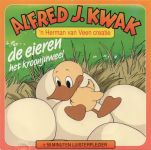 WSPCD 16093 De eieren (1990) (Dutch)
Books
Dutch
-
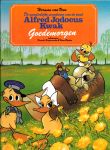
-
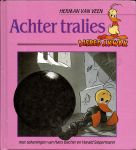 De wonderlijke avonturen van Alfred J. Kwak: Achter tralies (1989) (Dutch)
 -
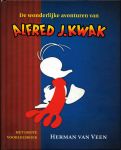
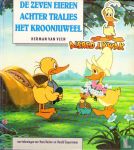 De wonderlijke avonturen van Alfred J. Kwak: Omnibus 1 (1989) (Dutch)
 -
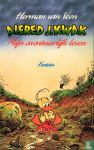 Alfred J. Kwak Mijn avontuurlijke leven (1991) (Dutch)
 -
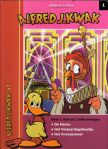 Alfred J. Kwak Filmstripboek Deel 1 (2006) (Dutch)
 -
External Links
- Watch the complete Alfred J. Kwak episode "Het verjaardagsfeestje" in Dutch on Harlekijn Holland's youtube page here.
|
Henk de Mol Main |
緒方 賢一 JPN |
[[File: Kenichi Ogata_Role.jpg|x90px]] |

Notes
References
- ↑ 1.0 1.1 "La gazza ladra page on Wikipedia". wikipedia.org.
- ↑ Seville, Adrian (2019-07-01). The Cultural Legacy of the Royal Game of the Goose. Amsterdam: Amsterdam University Press. p. 333-352. ISBN 9789048535880.
- ↑ "父さんはハンク (Tōsan wa Hanku)" [My father is Henk]. Alfred J. Kwak. Season 1. Episode 4. 1989-04-24. TV Tokyo.
- ↑
Siepermann, Harald; Bacher, Hans (1988). Character- and Color-Designs for Alfred J. Kwak. Duesseldorf - West-Germany.
{{cite book}}: CS1 maint: location missing publisher (link) Sheet 11 - ↑ van Veen, Herman; Holzhaus, Hanneke (1991). De Droom van Alfred Jodocus Kwak [Alfred Jodocus Kwak's Dream] (in Nederlands). Soest, the Netherlands: Harlekijn, Westbroek. ISBN 9063860862. Page 106
- ↑ 6.0 6.1 6.2 6.3 6.4 Alfred J. Kwak Opening Dutch credits. 24 December 1989. VARA
- ↑ Alfred J. Kwak Ending Dutch credits. 24 December 1989
- ↑ "European cartoon films; does anybody remember Alfred J. Kwak?". www.reddit.com. Reddit user theh1982 mentions that the series is available trough the Dutch Netflix.
- ↑ "Alfred J. Kwak Nu op Netflix". www.nuopnetflix.nl (in Nederlands).