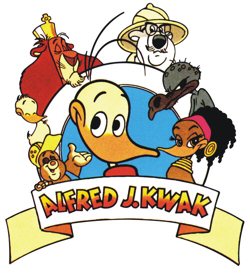
Alfred J. Kwak Episode 1
| Alfred J. Kwak "De Eieren" | |
|---|---|
| ← Season 1, Episode 1 → | |
| |
Animation Staff | |
| Episode direction | Masayuki Kojima |
| Animation supervisor | Kazuo Tomizawa |
| Episode storyboards | Hiroshi Saitō Harald Siepermann (uncredited) |
| Screenplay | Akira Miyazaki |
| Music | Herman van Veen Erik van der Wurff Nard Reijnders |
| Sound director | Shigeharu Shiba |
| Running time | 25 min |
| Original airdate | 3/4/1989 (Japan) |
| Original production episode number | 1 |


"De Eieren" (lit: The Eggs) or "アルフレッド誕生" (Arufureddo tanjō; lit: Alfred's birth) Is the first episode of Alfred J. Kwak's first season. The episode first aired in Japan on TV Tokyo on 3 April 1989 in the Monday 17:00 - 17:30 slot.
Story
Summary
The sun rises over Breed Rietland, and bees begin to pollinate the flowers, signaling the arrival of spring. A jet plane passes overhead as Henk de Mol emerges from his molehill. Checking the time, he remarks that Johan Sebastiaan Kwak is late for their meeting again. Meanwhile, Johan rushes to meet Henk, nearly getting run over while crossing the road. He arrives at the wrong tree and calls out for Henk, who redirects him to the willow where they had agreed to meet. Henk scolds Johan for his tardiness, but quickly adds that he is glad Johan kept his promise to meet.
Johan praises the arrival of spring and predicts something extraordinary will happen this year. Henk asks if Johan has any special plans, specifically suggesting marriage. Johan dismisses the idea, saying he is too young. At that moment, he hears the song of Anna van de Polder, who is picking flowers. Henk introduces Johan to Anna, and Johan, overwhelmed with nerves, struggles to speak coherently. Before he embarrasses himself further, he bids a quick farewell and runs off, sitting down in a pasture to dream about Anna. Unbeknownst to him, two heron surveyors, Stip and Stap, begin measuring the pasture around him.
The next morning, Johan wakes up and takes a dip in the river. Hearing Anna's voice in the distance, he heads toward her but quickly returns to the river to clean himself and brush his teeth. As he approaches Anna, another duck engages her in a one-sided conversation about tennis. Soon after, a second duck on a motorcycle arrives and attempts to impress Anna by doing loops around them. The first duck takes the key from the motorcycle which leads to a brawl between them. Anna walks away from the scene, and Johan approaches her, offering her a flower. In return, Anna kisses him. Elated, Johan jumps around joyfully and kisses both of the other ducks in his excitement.
As it begins to rain, Stip and Stap run for shelter under the willow tree where Johan and Anna are sitting. After the rain stops, Anna and Johan swim and dance under the moonlight. Shortly after, Henk attends Anna and Johan’s wedding.
Henk later comes over with flowers on a maternity visit to see Johan and Anna’s clog filled with seven eggs. Meanwhile, Rap de Kiekedief spies on them through binoculars.
In a chic room, Olaf Nijlpaard[note 1], manager of Groot Speelgoedland, shows A. Rokodil, the investor, a miniature model created by Stip and Stap, who are present alongside Bart 'Beton' Bever, the construction supervisor and director of the Beton Maatschappij. Nijlpaard explains plans to build a large theme park called Groot Speelgoedland right on top of the pasture where Johan and Anna live.
Johan paces nervously, waiting for the eggs to hatch, while Henk passes by. Johan tries to appear calm but quickly loses his composure. Anna asks Johan to watch the eggs while she takes a break. Just as Henk leaves, Schor de Kraai and Miriam Merel judge the eggs, loudly proclaiming they will likely spoil before hatching. Angered, Johan takes back the egg Schor is holding. At that moment, Rap, disguised as a bush, sneaks in and steals an egg. Johan chases after Rap, who bumps into Henk, causing the egg to soar into the air. The egg bounces off the tennis racket of the tennis-obsessed duck and lands in the water, where Snel de Snoek swallows it whole. Johan pulls him out of the water and forces him to spit the egg out.

As Henk scolds Rap, Johan returns to receive a scolding from Anna. Johan confidently reassures her that the egg is safe, but when he shows her, only pieces of the shell remain. They soon spot a duckling nearby. Henk helps the duckling back home and suggests naming him after his grandfather, Alfred de Mol, who also ran away when he was young. He adds that Jodocus means "Joker" or "Trickster," and Johan and Anna agree to name him Alfred Jodocus Kwak. Just as they make the decision, Alfred’s other brothers and sisters hatch.
As the ducklings are fed, Alfred gets distracted by bugs (among which a duizenpoot) and wanders off. He crosses the same road Johan crossed at the start of spring, unaware of the danger of cars. Rap sets his sights on Alfred and begins stalking him, but Henk catches on and intervenes, beating Rap up.
Alfred is returned to his family, but suddenly, the clog and the ground around them begin to rise, lifted by a giant excavator. Johan keeps his children safe while Anna is asked to leave by Olaf Nijlpaard. The neighborhood is filled with construction machinery tearing up the land. Olaf Nijlpaard, A. Rokodil, and Bart 'Beton' Bever are interrupted by Johan, who asks if they have a permit to build on the land. Nijlpaard assures him they do, and the businessmen drive off in their expensive car.
As night falls, Anna, Johan, their children, and Henk watch the construction progress. Henk shows Johan a photo of his grandfather, Alfred de Mol, posing in front of a mine house in Groot Waterland, a peaceful place. Henk suggests Johan move his family there. Johan decides to think about it.
That night, curiosity gets the better of Alfred, and he sneaks out of the clog to explore. He wanders through the abandoned theme park and stumbles upon a building with a giant animatronic ape. Startled, Alfred screams when he realizes he has a voice. After relaxing upon realizing the ape is fake, he accidentally pulls a lever that activates the animatronic, causing it to move and make noise. Terrified, Alfred runs back to the clog and his family.
Language and Regional Variations
- The following lists differences between the Dutch version and other versions. For detailed information on music differences check the Music section. General differences between series like names can be found at Alfred J. Kwak Production

- In the Japanese version Anna hums a tune very close to the song . The Dutch and English version have a different version.
- In the German version Anna is introduced as being the youngest daughter of the dyke builders and is not given a surname.
- In the Dutch version Johan Sebastiaan Kwak hums along with the background music In De Val while trying to court Anna.
- In the English version, Herman van Veen's voice is retained in the mix as Johan jumps up and down after being kissed by Anna (in the German version, Herman van Veen does not re-record this part). Later, when Johan tries to hold all his children while being lifted by the excavator, the English version also retains van Veen's original voice. Similarly, Alfred's voice remains in the mix when he leaves the clog for the first time. When Alfred later wanders off to the theme park, his Dutch voice, provided by Ryan van de Akker, is mixed with the English voice, performed by Jill Lidstone[1], though a voice filter is applied to raise the pitch.
- The English version has Olaf Nijlpaard say that the theme park is "truely a fairy tale land", mentioning the original name of the park "SPROOKJESPARK" from the original script. The Dutch version turns this into Groot Speelgoedland.
- In the English version, Alfred's name is changed to Alfred Jonathan Quack. As a result, the script is altered so that, instead of Henk mentioning his grandfather's nickname, he refers to his middle name, Jonathan.
Continuity
- Although unnamed, the family of bees, consisting of Mevrouw Bij, Mevrouw Bij's son and Willem Bij, have their first appearance at the very start of this episode. Their first speaking roles will be in Alfred J. Kwak Episode 21.
- Several characters in this episode can be interpreted as the parents of characters who appear later in the show. For example, the parents of Dolf are explicitly shown, as well as characters who are likely the fathers of K. Rokodil, Hannibal Nijlpaard and Bert 'Beton' Bever. Additionally, the two kemphanen (ruff birds) bear a strong resemblance to the older versions of Hannes and Wannes. However, this interpretation is complicated by the fact that Hannes and Wannes are brothers. One possible explanation is that the character resembling an older Wannes could actually be the father of a character originally named Hans Gans, but later renamed to Wannes in the series, suggesting that what were initially two distinct characters became merged into one.
- Any character depicted as a parent of those appearing later in the series must also have emigrated to a similar location in Groot Waterland as the Kwak family would attempt to in the next episode. This migration could also have been a direct reaction to the construction of the theme park or could have occurred for other reasons.

- Several parallels can be drawn between Johan Sebastiaan Kwak and his son, Alfred Jodocus Kwak, in how they respond to their respective crushes and later spouses. Both characters exhibit similar behaviors, such as stammering and speaking incoherently when nervous. Additionally, both offer a bouquet of daisies to their partner. In the Dutch version, the voice actors for both characters, Herman van Veen (Johan) and Ryan van den Akker (Alfred), perform the song Nog Nooit as an insert.[2] Both couples are also featured in symbolic dance scenes: Johan and Anna are depicted dancing in the clouds, while Alfred and Winnie are shown dancing among the glass artwork created by the Dodos.[3]
- Rap is confronted by Henk on how he should've flown up into the sky if he was in a hurry. Rap is confused himself why he didn't fly up. This highlights the fact that while Alfred and the other ducks should be able to fly, but never do so in the series.
- Dolf's parents feature in this episode at Schor de Kraai and Miriam Merel. While Schor is a crow, Miriam is actually a blackbird. This will later result in Dolf being born a crow with a yellow beak.[4]
- Alfred's brothers and sisters are given individual names in the book De wonderlijke avonturen van de eend Alfred Jodocus Kwak: Goedemorgen. They were named Josefien, Clara, Marjolein, Hans, Jan and Robbie.[5]
- Alfred references being driven away from their birthplace, because of the Beton Maatschappij in Episode 31.
- Groot Speelgoedland is shown in its completed form in Episode 42. It is also shown from a distance in Episode 2.

Cultural references

- Breed Rietland is likely modeled after Germany, but possibly also after the Netherlands or Belgium.
- Johan Sebastiaan Kwak's character design is based on the appearance of Herman van Veen, the creator of the series.
- Johan sleeps and lives in a huge clog. Clogs are a type of footwear that is typically made of wood, traditionally worn in agriculture and in some factories and mines, in large parts of Europe since before the Middle Ages.[6][7] While they were used in many different countries, it is likely clogs are traditionally associated with the Netherlands due to their widespread trading history.[8]
- Anna van de Polder is wearing a hul or Dutch cap/bonnet. The hul is part of a traditional Dutch women's costume worn in the nineteenth century, usually worn by fisherwomen on the North Sea Coast of the Netherlands. The one worn by Anna seems to resemble a Volendam hul.[9]
- The wind-up duck placed on the diorama by Olaf Nijlpaard bears a striking resemblance to Donald Duck, possibly equating Groot Speelgoedland to Disneyland.
- Schor de Kraai and Miriam Merel both wear traditional German clothes. Schor wears lederhosen, which are traditional leather breeches worn by men in South-Germany, Austria, Bavaria, South Tyrol and Slovenia.[10] As their son Dolf will later change into a dictator akin to Adolf Hitler this connection is made stronger by the clothes they are wearing. The clothes could also indicate that Breed Rietland is intended to be a stand-in for Germany. Additionally, Schor speaks with a German accent and occasionally incorporates German words into his dialogue.
Errata
- The English DVD release of this episode seems to have a doubling effect in the music and effects track; the track is overlayed and the timing is slightly off, creating an echo.
- In the original script by Herman van Veen, a longer period—spanning several weeks—passes between the start of the theme park's construction and the Kwak family's departure. However, in the televised episode, it appears as though the construction team completes a significant portion of the park in just one day. This is evidenced by the presence of a large tent and a robotic gorilla that frightens Alfred, suggesting an accelerated timeline in the adaptation. This error is corrected in the adaption De wonderlijke avonturen van de eend Alfred Jodocus Kwak: Goedemorgen.

- Small animation error as the little duck wind-up toy that Olaf Nijlpaard let's walk around on the miniature set. The robot only seems to have feet when his feet touch the ground.
- Olaf Nijlpaard explains that they're going to build Groot Sprookjesland as the biggest amusement park in Groot Waterland, however the pastures they are going to build on are in Breed Rietland. Later on in the episode Johan also calls Alfred Jodocus Kwak a healthy Waterlander.
- In the Dutch version Johan Sebastiaan Kwak and Henk de Mol discuss the name Alfred and conclude that it means "prankster" or "joker". However Jodocus (or sometimes Jodokus) doesn't actually mean that. It has several different meanings:
- In the English version, Henk mentions his grandfather and explains that Henk's parents named him Alfred, which is uncommon, as parents are typically not named by their children.
- In the English version when Olaf Nijlpaard, A. Rokodil and Bart 'Beton' Bever drive away Johan is missing voice lines.
Cast
Character Gallery
The characters in order of appearance.
-
-
-
 Jan van de Polder (mentioned)
 -
-
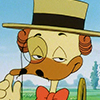 Henri Dropshot (not named)
 -
Johnny Hollyday (not named)
-
-
Olaf Nijlpaard (not named)
-
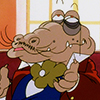
-
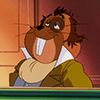
-
Miriam Merel (not named)
-
Snel de Snoek (not named)
-
Animatronic gorilla
Voice Actors
| 緒方 賢一 Kenichi Ogata |
¦ | ハンク (Hanku) Hank (Henk de Mol) |
| 吉村 よう Yō Yoshimura |
¦ | ヨハン・クワック (Yohan Kuwakku) Johan Kwak (Johan Sebastiaan Kwak) |
| 安達 忍 Shinobu Adachi |
¦ | アンナ・ポルダー (Anna Porudā) Anna Polder (Anna van de Polder) |
| 島田 敏 Bin Shimada |
¦ | 青年 (Seinen) Young man (Henri Dropshot) |
| 鈴置 洋孝 Hirotaka Suzuoki |
¦ | ハリアー (Hariā) Harrier (Rap de Kiekendief) |
| 神山 卓三 Takuzō Kamiyama |
¦ | ヒポポタマス (Hipopotamasu) Hippopotamus (Olaf Nijlpaard) |
| 立木 文彦 Fumihiko Tachiki |
¦ | クロコダイル (Kurokodairu) Crocodile (Alfons Rokodil) |
| 山寺 宏一 Kōichi Yamadera |
¦ | ニコル (Nikoru) Nicol (Schor de Kraai) |
| 鈴木 れい子 Reiko Suzuki |
¦ | ニコルの妻 (Nikoru no tsuma) Nicol's Wife (Schor's wife) |
| 林原 めぐみ Megumi Hayashibara |
¦ | アルフレッド・ヨードカス・クワック (Arufureddo Yōdokasu Kuwakku) Alfred Jodocus Kwak |
Main staff
- Original idea and storylines: Herman van Veen[14]
- Series director: Hiroshi Saitō[14]
- Excecutive producer: Dennis Livson[15]
- Producers: Manabe Tamura (Telescreen), Mutsuo Shimizu, Sumio Takahashi (Teleimage)
- Production managers: Manabe Tamura, Tamehide Hyakuzuka, Tsuneomi Nakamura[note 3] (TV Tokyo)
- Screenplay: Akira Miyazaki
- Animation supervisor: Kazuo Tomizawa
- Director of photography: Hisao Shirai
- Character designs: Harald Siepermann[14], Hans Bacher, Susume Shiraume, Masaru Amamizu
- Background designs: Hans Bacher
- Episode director: Masayuki Kojima
- Assistant director: Masaaki Kumagai
- Storyboard director: Akira Miyazaki
- Storyboard supervisor: Harald Siepermann
- Storyboard artist: Hiroshi Saitō, Harald Siepermann (uncredited)
- Key animation: Jōji Yanase, Minoru Kibata, Hiroshi Dobashi, Kaku Saito(?), Asunaro Studio, Emiko Kataoka, Yukari Watanabe, Tetsuro Kaku, Yumi Chiba
- Backgrounds: Hiroshi Yoshikawa, Maki Yoneda, Yukari Oba(?), Studio Uni
- Music: Herman van Veen[14], Erik van der Wurff[14], Nard Reijnders
- Lyrics: Herman van Veen
- Sound director: Shigeharu Shiba
- Sound mixing: Kunio Kuwahara
- Sound effects: Kazutoshi Satō (E&M Planning Center)
- Sound staff: Fujio Yamada, Shigeki Oashi(?, possibly correct)
- Sound produced by: Omnibus Promotion
- Recording studio: New Japan Studio
Localization staff
- Dubbing: J.P.S. Studio
- Technical Director: Joop Pieete
- Dutch Texts: Herman van Veen
- Script Adaptation: Vivian Pieters
- Production and Direction: Vivian Pieters
- Dutch Version: Telecable Benelux B.V., commissioned by Vara
- Dubbing: F.C.F. Film Synchronization, Berlin, commissioned by ZDF, ORF and SRG
- Dialogue editing and direction: Friedbert Cierpka
- ZDF Editorial Team: Markus Schächter, Dorothee Herrmann
- Dubbing: E.P.K Work in Arts, Bray Studios UK
- Direction: Stanley Joseph
- Dubbing editor: Russell Shaw
Locations

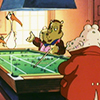
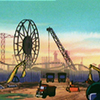
Production
Scripts
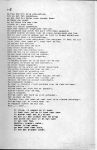
Read the original outlines written by Herman van Veen down below.
-
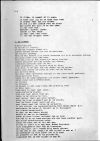 Page 1
 -
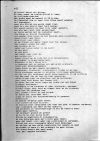 Page 2
 -
 Page 3


Expand original Dutch text and English translation
| ||||||||||||
|---|---|---|---|---|---|---|---|---|---|---|---|---|
|
In the original outline written by Herman van Veen, the episode ends right after Alfred's family was run over by a car.[16] This was later changed to happen in Episode 2. There are many minor changes between the original script and the final episode, but the biggest changes include:
- The order of events has been slightly changed. For example, the scene in the office with Alfons Rokodil and Olaf Nijlpaard discussing over a model version of the amusement park is moved to earlier on in the story. The hatching of Alfred's egg also happens earlier, as the egg is seen waggling by Johan, Anna and Rap in the script, but only hatches after Johan has saved Alfred from Rap and Snel in the episode. Finally, Henk offering the idea to emigrate is before Alfred goes to the attractionpark in the episode, but after in the script. This was likely reworked to make Alfred returning to the nest after being scared in the park (plus the lingering question of emigration) the ending to the episode.
- The passage of time is also different between each versions. It seems like a few days pass after Alfred and his brothers and sisters hatch in the episode before they are interrupted by construction work, but in the script it's almost simultaneous. Conversely, in the script several weeks go by before Johan, Anna and Henk decide to emigrate, but in the episode they only sleep on that decision for one night. However Episode 2 keeps it ambiguous how much time transpired between episodes.
- In the eventual episode Henk is not the one missed by the car, but Johan is.
- Johan originally drove the two drakes that are fighting over Anna apart, but in the episode the drakes turn on each other and Johan uses this opportunity to start a conversation with Anna.
- Schor de Kraai, who turns out to be Dolf de Kraai's father, visits the clog while Anna goes to the bathroom in the episode, but in the original script Schor actually steals one of the eggs.
- Henk plays a much larger role in the episode. In the script he's absent until the Kwak family is thinking of moving, while in the episode he's there when Johan and Anna get married, have eggs, and is involved in Johan's fight to get Alfred's egg back from Rap.
- In the original script, when Johan gets Alfred home all Alfred's brothers and sisters have already hatched, making it unclear if Alfred was the eldest, while in the episode this remains unambiguous.
- The episode adds an extra storybeat in which Rap tries to eat Alfred as a little duckling. This is completely absent from the script version and was likely added to pad the runtime.
- In the Dutch version of the episode the name of the amusement park, "SPROOKJESWERELD" (Fairy Tail World), was changed to "GROOT SPEELGOEDLAND" (Great Toy Land) in the episode.
- In the episode version Henk mentions the mine his grandfather owned as a place to move to. This hadn't been added yet in the script stage.
Character Designs
- The episode numbers listed in this section are the original production numbers and may not align with the final episode order.
-
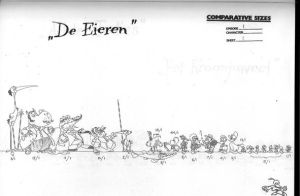 Character line-up for "De Eieren".

For this episode 21 characters (including all Alfred's brothers and sisters were designed by Harald Siepermann and Hans Bacher, based on the script outline by Herman van Veen. Several other characters appear, for example Dolf's mother, but her Character model sheet is labelled as Episode 5 and 6, even though she does not appear in those. Other characters not included in designs specifically linked to this episode are Willem Bij and his family who appear in the second cut of the episode. They were originally designed for Episodes 7 and 22. Another character remains unnamed, but the character design sheet calls this character De Duizendpoot (the centipede) which shows up walking by when Alfred is sitting in the clog with his brothers and sisters.
Also a character design for a young Hannibal Nijlpaard appears in the original line up, who at some stage of the production might've been part of the story. Character model sheets for Big, Hannes and Wannes are also linked to this episode (as they are linked to episodes 1-6), but do not appear in the episode, nor in the line up.
Characters designed for this episode were drawn primarily in March through August of 1988, with Alfred's design as a small child designed last.[17]
Storyboarding
After Herman van Veen had written the outlines for all 52 episodes and Harald Siepermann and Hans Bacher had finished the Character- and Color-Designs for Alfred J. Kwak book, the Japanese animation team, lead by Hiroshi Saitō, created the first storyboard drafts. It quickly became evident that the animation studio's interpretation differed significantly from the vision of the creative team. The studio's depiction of the world resembled Saitō's previous projects, such as Kimba the White Lion or ジャングル大帝 (Janguru Taitei, lit: Jungle Emperor), portraying the characters as more animalistic, often walking on all fours.
At the time, Siepermann was the only member of the creative team present in Japan. Due to the hierarchical nature of Japanese culture, he was unable to directly instruct Saitō to implement changes. Instead, they met discreetly, with an interpreter as the only witness, to discuss revisions to the episodes and storyboards. Siepermann created corrected storyboards in a hotel at night, which Saitō then redrew, reversing the orientation from left to right, and presented as his own to his team. Although the staff was aware of this arrangement, it allowed Saitō to maintain face in front of his colleagues. Additionally, Saitō needed convincing about the storyline involving Alfred's parents fleeing their homeland, as such actions were considered treasonous in Japanese culture[18][19].
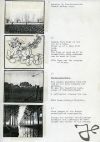
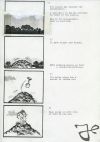
Below are the storyboards for episode 1 as drawn by Harald Siepermann.
-
 Page 1
 -
 Page 2
 -
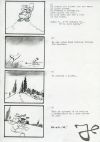 Page 3
 -
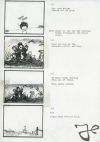 Page 4
 -
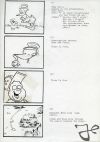 Page 5


Sound
Music
The following table is a list of the musical cues used in this episode, accompanied by our in-house music ids.
The Opening and Ending songs Yakusoku Dayo and Happy Happy are sang by Megumi Hayashibara.
A8 / Nog Nooit is sang by Herman van Veen.
| Alfred J. Kwak: Episode 1 Japanese OST | |||||
|---|---|---|---|---|---|
| Catalogue | NTSC Time Range | Title | Literal Translation | Wiki ID | |
| OP | 0:00 - 1:30 | It's a Promise | |||
| TC | 1:31 - 1:36 | ||||
| A1 | 1:36 - 2:58 | Spring in Groot Waterland | |||
| A2 | 3:10 - 3:35 | Splash, pitter, patter | |||
| A3 | 4:11 - 4:20 | ||||
| A4 | 5:30 - 5:40 | ||||
| A5 | 6:21 - 7:06 | Trapped | |||
| A6 | 7:34 - 7:49 | ||||
| A7 | 8:07 - 8:32 | Trapped | |||
| A8 | 8:34 - 9:53 | I Have Never | |||
| A9 | 10:04 - 11:04 | K. Rokodil | |||
| A10 | 11:54 - 11:57, 13:06 - 13:09 |
||||
| B1 | 13:10 - 13:08 | ||||
| B2 | 14:57 - 15:03 | ||||
| B3 | 15:14 - 16:20 | So Cheerful | |||
| B4 | 16:47 - 17:29 | Trapped | |||
| B5 | 17:43 - 18:31 | ||||
| B6 | 18:54 - 19:22 | K. Rokodil | |||
| B7 | 20:01 - 20:25 | K. Rokodil | |||
| B8 | 20:27 - 21:24 | ||||
| B9 | 21:26 - 21:58 | ||||
| B10 | 22:34 - 22:44 | Help Help | |||
| B11 | 22:48 - 23:00 | To Take Shelter | |||
| NEP[note 7][20] | TODO | ||||
| ED | TODO | Happy Happy | |||
| Alfred J. Kwak: Episode 1 Dutch OST | |||||
|---|---|---|---|---|---|
| Catalogue | PAL Time Range[note 8] | Title | Literal Translation | Wiki ID | |
| OP | 0:00 - 1:28 | Splash, pitter, patter | |||
| A1 | 1:28 - 2:45 | Spring in Groot Waterland | |||
| A2 | 2:56 - 3:21 | Splash, pitter, patter | |||
| A3 | 3:53 - 4:04 | ||||
| A4 | 5:12 - 5:21 | ||||
| A5 | 6:01 - 6:43 | Trapped | |||
| A6 | 7:10 - 7:34 | ||||
| A7 | 7:42 - 8:06 | Trapped | |||
| A8 | 8:08 - 9:23 | I Have Never | |||
| A9 | 9:34 - 10:31 | K. Rokodil | |||
| A10 | 11:20 - 11:23, 12:28 - 12:31 |
||||
| B1 | 12:32 - 12:58 | ||||
| B2 | 14:15 - 14:21 | ||||
| B3 | 14:30 - 15:33 | So Cheerful | |||
| B4 | 16:00 - 16:40 | Trapped | |||
| B5 | 16:54 - 17:39 | ||||
| B6 | 18:01 - 18:29 | K. Rokodil | |||
| B7 | 19:05 - 19:28 | K. Rokodil | |||
| B8 | 19:30 - 20:25 | ||||
| B9 | 20:27 - 20:58 | ||||
| B10 | 21:32 - 21:42 | Help Help | |||
| B11 | 21:46 - 21:57 | To Take Shelter | |||
| ED | 21:58 - 23:00 | So Cheerful | |||
Sound Effects
| Alfred J. Kwak: Episode 1 Japanese SFX | ||
|---|---|---|
| NTSC Timestamp | Title | SFX Wiki |
| 0:03, 1:25, ?:?? | kwak kwak | link |
| ?:??, ?:?? | Sound Ideas, BOING, CARTOON - HOYT'S BOING | link |
Availability
This episode has been released in the following formats.
VHS
Dutch
-
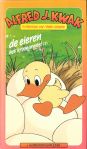 SKV 037 De eieren (1989) (Dutch)
 -
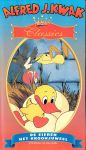 SKV 145 Classics: De Eieren (1990) (Dutch)
 -
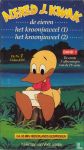 Alfred J. Kwak Band 1 (1990) (Dutch)
Finnish
-
 I-07116 Alfred J. Kwak - Kuinka Kaikki Alkoi (1995) (Finnish)
French
-
410001 Alfred J. Kwak - Nº1 (Unknown) (French)
-
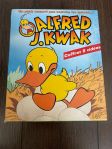 Alfred J. Kwak - Coffret 6 vidéos (VHS Box, WS 557) (1998) (French)
German
Hebrew


DVD
Dutch
-
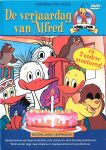 MBI 6067 De verjaardag van Alfred (2004) (Dutch)
 -
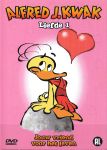 DDVD 904247 Liefde 1 (2006) (Dutch)
Finnish
-
Alfred J. Kwak (DVD Box, 7802) (2009) (Finnish)
-
Alfred J. Kwak - 1 Jaksot 1-7 (DVD, 7855) (2009) (Finnish)
German
-
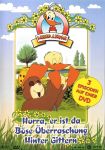 PTD 2834 Episode 1, 2, 3 (2001) (German)
Streaming
Dutch
- The complete episode is available in Dutch on Harlekijn Holland's YouTube page down below.
Removed
- The series used to be available trough Netflix in the Netherlands around 2015[21], but was removed sometime after[22].
Adaptations
Several adaptations have been made of the story contained in this episode.
Audio cassette
Dutch
-
 MC 16093 De eieren (1990) (Dutch)
CDs
Dutch
-
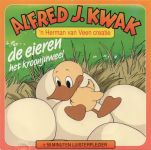 WSPCD 16093 De eieren (1990) (Dutch)
Books
Dutch
-
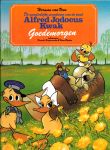
-
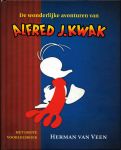
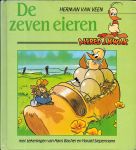 De wonderlijke avonturen van Alfred J. Kwak: De zeven eieren (1989) (Dutch)
 -
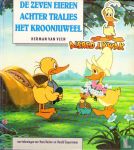 De wonderlijke avonturen van Alfred J. Kwak: Omnibus 1 (1989) (Dutch)
 -
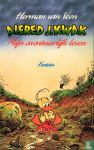 Alfred J. Kwak Mijn avontuurlijke leven (1991) (Dutch)
 -
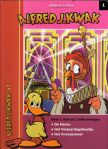 Alfred J. Kwak Filmstripboek Deel 1 (2006) (Dutch)
 -
German
-
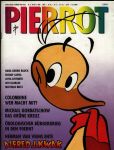 Guten Morgen comic as featured in the magazine Pierrot (1990) (German)
External Links
- Watch the complete Alfred J. Kwak episode "De Eieren" in Dutch on Harlekijn Holland's youtube page here.
Notes
- ↑ We're given Olaf Nijlpaard's first name in De wonderlijke avonturen van de eend Alfred Jodocus Kwak: Goedemorgen
- ↑ Miscredited on [[wikipedia:IMDb|]] and several other pages as Paul van Vliet
- ↑ In the Dutch version credited as Tuneomi Nakamura
- ↑ In Dutch, "Snateren" means to talk a lot or to quack.
- ↑ In Dutch, a "Kemphaan" is someone who likes to enter into discussion, but literally it's also a bird, belonging to the order of waders, and the size of an ordinary turtledove.
- ↑ Herman van Veen erroneously calls Breed Rietland 'Breed Waterland', making it an amalgamation of Breed Rietland and Groot Waterland.
- ↑ It is currently unknown if the Japanese version included the episode previews, however the Mandarin version used as the music for it.
- ↑ Time ranges taken from the DDVD 904247 Liefde 1 DVD release.
References
- ↑ "Alfred J. Kwak page on dubbing fandom wiki". dubbing.fandom.com. Fandom user Bladez636 observed that Jill Lidstone's character Curly in the cartoon Dennis the Menace & Gnasher (1996) sounds extremely similar to Alfred's voice in the English dub.
- ↑
"[[Alfred J. Kwak Episode {{{2}}}|]]". Alfred J. Kwak. Season Expression error: Unrecognized punctuation character "{".. Episode {{{2}}}. N/A. Unknown.
{{cite episode}}: Check date values in:|airdate=(help) - ↑
"[[Alfred J. Kwak Episode {{{2}}}|]]". Alfred J. Kwak. Season Expression error: Unrecognized punctuation character "{".. Episode {{{2}}}. N/A. Unknown.
{{cite episode}}: Check date values in:|airdate=(help) - ↑
"[[Alfred J. Kwak Episode {{{2}}}|]]". Alfred J. Kwak. Season Expression error: Unrecognized punctuation character "{".. Episode {{{2}}}. N/A. Unknown.
{{cite episode}}: Check date values in:|airdate=(help) - ↑ van Veen, Herman (1989). De wonderlijke avonturen van de eend Alfred Jodocus Kwak: Goedemorgen. Artwork by Harald Siepermann & Hans Bacher. Soest: Harlekijn Uitgeverij. ISBN 9063860706. Page 25.
- ↑ "Clog page on Wikipedia". en.wikipedia.org.
- ↑ "Clog page on Wikipedia". nl.wikipedia.org (in Nederlands).
- ↑ "De oorsprong van de klomp". www.olddutch.nl (in Nederlands). Hotel Old Dutch.
- ↑ "Dutch Hul page on Wikipedia". nl.wikipedia.org (in Nederlands).
- ↑ "Lederhosen page on Wikipedia". en.wikipedia.org.
- ↑ "24Baby name meaning for Jodocus". www.24baby.nl (in Nederlands).
- ↑ Laps, Kristiaan (1984). Nationaal Scheldwoordenboek. Ploegsma. ISBN 9021608561.
- ↑ "Ensie page on Jodocus". www.ensie.nl (in Nederlands). October 16, 2022.
- ↑ 14.0 14.1 14.2 14.3 14.4 Alfred J. Kwak Opening Dutch credits. 24 December 1989. VARA
- ↑ Alfred J. Kwak Ending Dutch credits. 24 December 1989
- ↑ Harald Siepermann (16 October 2005). "The original treatment of the first TV-episode". alfredjkwak.blogspot.com.
- ↑
Siepermann, Harald; Bacher, Hans (1988). Character- and Color-Designs for Alfred J. Kwak. Duesseldorf - West-Germany.
{{cite book}}: CS1 maint: location missing publisher (link) - ↑ Harald Siepermann (15 October 2005). "The first spread of Guten Morgen in Pierrot". alfredjkwak.blogspot.com.
- ↑ Maarten Mulder (3 April 2019). "30th anniversary Alfred J. Kwak". haraldsiepermann.com.
- ↑ Jack3376 (22 March 2010). "福星鸭小子1下". v.youku.com (in 中文). Retrieved 22 October 2024.
{{cite web}}: CS1 maint: numeric names: authors list (link) - ↑ "European cartoon films; does anybody remember Alfred J. Kwak?". www.reddit.com. Reddit user theh1982 mentions that the series is available trough the Dutch Netflix.
- ↑ "Alfred J. Kwak Nu op Netflix". www.nuopnetflix.nl (in Nederlands).